Colorado Business Formation Lawyer
Successful Entrepreneurs Trust Our Colorado Business Formation Lawyer
Have an idea for a business? Where do you start transforming that idea into a business? Determining business formation is one of the first and most important steps to starting a business in Colorado. It can make a difference in terms of taxes, liability, profitability, growth, and more. Getting it right from the very beginning is critical.
At Volpe Law, our business attorney will review your business idea with you and advise you on all your best legal options. From that point on, our business attorney will guide you through the process, proactively making sure you have all the forms, documentation, and other necessary information and strategies in place for a successful venture. Contact our business lawyer today at 720-770-3457 or complete our Consultation Form to schedule a complimentary discovery call.
When starting a new business venture, don’t neglect the importance of proper business entity formation. First-time business owners may not realize that the differences in legal business formation structures (LLC, PLC, corporation, S-Corp, or nonprofit) greatly impact the venture’s tax obligations, ownership limitations, and overall operations.
It’s not just the legal steps of forming your business that are critical to its success. Your contracts, including employment contracts, vendor agreements, and partnership agreements, also play a large role. We draft contractor agreements for your business and review those you’re presented with. Our Colorado business formation lawyer oversees all the legal matters necessary to open your doors. Contact us today for a professional complimentary discovery call.
Comprehensive Business Legal Services
Colorado businesses have strict regulations for operation, financial reporting, and taxation. The nature of your enterprise and your goals (would you like to remain small, or do you have expansion plans, for example) affect which type of business formation structure is right for you. Our firm prepares the right business formation documents, acquires any permits and other supporting documentation, and registers it with the Colorado Secretary of State.
The type of business formation you choose can affect your ability to expand and take on new partnerships. If you want to keep your business privately owned, an LLC may be your best option, protecting your personal assets from being seized by creditors. However, if you are considering taking the business public, then a corporation form may work best. We work with you to develop your business goals, to form the business in the manner that’s best to achieve them.
Finally, we ensure that your business complies with industry-specific regulations. Certain industries, like electrical work or food and beverage service, have specific regulations. All businesses must also comply with state and federal employment laws. Part of our business formation services includes advising you on employment law compliance and risk assessment.
You can effectively leave your business’s legal interests to us and concentrate on what you do best—running your business.
Legal Protection So Your Business Can Thrive
One bad business deal, one hotly contested business dispute, or one premises liability lawsuit can derail your business or even cause you to shutter. We provide legal protection, including risk assessment and analysis. We alert you to areas where your business could be exposed, like employment violations or hazardous conditions that could cause workplace or guest injury. Then, we present an actionable plan to get your business compliant and address the risks.
If you face a contract dispute, including a breach of contract, we can represent your interests in arbitration, mediation, and Colorado civil court. A breach of contract can affect your supply chain, threaten your reputation, and cost a lot of money. We address the nature of the breach and attempt to negotiate a resolution according to the contract’s terms. However, if we cannot resolve this with the breaching party, we initiate legal action on your behalf.
At Volpe Law LLC, we take your business goals seriously, starting with the enterprise’s legal formation. Please contact us today for a personalized complimentary discovery call with our Colorado business formation lawyer.

HOW DO YOU FORM A BUSINESS IN COLORADO?
When forming a business, one of the first and most important decisions to make is the structure you will use. A business structure is the legal classification of a business that determines taxes, liability, and other legal rights and responsibilities.
A range of business structures is available, such as:
- Sole proprietorship
- General partnership
- Limited liability partnership (LLP)
- Limited partnership (LP)
- Limited liability limited partnership (LLLP)
- Limited partnership association (LPA)
- Limited liability company (LLC)
- Corporation
- Cooperative
The best business structure for your business depends on a range of different factors.
FIVE IMPORTANT WAYS A LAWYER CAN HELP YOUR BUSINESS IN COLORADO
A business lawyer can advise you on a range of issues when forming a business.
1. CHOOSING THE RIGHT STRUCTURE FOR YOUR BUSINESS
Choosing the right structure is the key to building a strong foundation for your business and its future growth. A business lawyer can advise you on the pros and cons of each structure available to you, relevant to your circumstances.
This will help protect both your interests and your business’s interests in the future.
2. INDUSTRY-SPECIFIC ADVICE
A business lawyer can give you advice specific to the industry in which you operate, as well as the product or service you’re offering. This includes assisting you with understanding the applicable regulations and any necessary licenses or permits.
3. DRAFTING AND NEGOTIATING LEGAL DOCUMENTS
Business formation typically involves the preparation of a range of documents, such as business registration papers, intellectual property registrations, and other commercial documents. A lawyer can assist you in accurately drafting these documents.
Importantly, a business lawyer can draft legally binding contracts or negotiate the terms of a contract to benefit you and your business. These are essential to many aspects of running a business, for example, partnership agreements.
4. UNDERSTANDING YOUR TAX OBLIGATIONS
Failing to properly understand your tax obligations can result in significant tax liability down the track. Taxation is a complex area so engaging a business lawyer, along with a qualified accountant or tax professional, is the best way to ensure compliance.
A qualified tax professional can also advise you about what tax breaks, credits, and deductions are available based on your business’ structure and circumstances.
5. EMPLOYMENT LAW
If you hire employees, you must comply with a suite of employment laws and regulations. State labor law is a political and constantly evolving area of law. A business lawyer can help you navigate these changes and draft effective employment contracts that protect both you and your employees.
Termination especially can be a legal minefield, so reliable legal advice on this is essential.
Skilled Legal Assistance Properly Establishing Your New Business Venture
Properly setting your business up at the outset prevents many serious legal problems down the road. From submitting the correct formation documents and registering the entity with the Colorado Secretary of State to negotiating favorable contracts, our Colorado business formation lawyer protects your new enterprise.
Types of Business Formation Matters We Handle
- Entity Formation: We explain the differences in business structures (LLC, corporation, partnership, etc.) and how each type could help you accomplish your vision for your new business. We also complete and file all necessary paperwork with the proper government agencies.
- Drafting Legal Documents: We draft corporate bylaws, LLC operating agreements, partnership agreements, and other essential documents, including the founder’s statements.
- Compliance: Our attorneys ensure that your business is compliant with state and federal regulations related to its formation and operation. We also ensure that your enterprise complies with industry-specific regulations, like OSHA regulations, and conduct regular risk assessments.
- Governing Documents: We draft government documents to minimize disputes, clearly outline roles and responsibilities, protect the interests of partners, investors, and stakeholders, and negotiate favorable terms for your entity.
- Business Agreements: Our attorneys draft, negotiate, and review commercial leases, sales agreements, non-disclosure and non-compete agreements, intellectual property use, franchise agreements, and employment contracts.
- Mergers and Acquisitions: We handle the legal aspects of mergers and acquisitions, including negotiating favorable terms for each deal, completing due diligence, and executing all necessary legal documents to complete the process.
- Business Dissolution: When it’s time to close the doors, we guide you through the process of dissolving or ending a business.
- Intellectual Property: We protect your business’s intellectual property, including filing for the appropriate legal protections and preserving your brand integrity. We also initiate legal action in cases of IP misuse or appropriation.
- Start-up Advice: We offer guidance for businesses in their early stages, including general counsel services.
Why Experience Matters in Colorado Business Formation
Understanding the legal requirements for forming a business is essential. Any errors or omissions in your business formation documents or oversights when drafting contracts can cost your company millions. Instead, turn to experienced attorneys who pay close attention to detail, strictly comply with state and federal regulations, and are committed to your business success.
- Ben Volpe, founder of VLope Law, was selected by Super Lawyers® as one of its Rising Stars, Colorado, for three years in a row. This distinction is awarded to only the top 2.5% of attorneys in the state.
- Volpe Law was recognized by Martindale-Hubbell® for the Gold Level Client Champion Award in 2022
- We received an A rating by Martindale-Hubbell®’s AV Preeminent Peer Review Rating, which has been used to recognize lawyers for their legal ability and ethical standards for over 100 years.
- Volpe Law holds a perfect 10.0 rating on Justia, the nation’s preeminent source of free legal information and resources, including a comprehensive database of legal cases.
Your business success starts with the right business formation. Volpe Law, LLC, can help you get started on the right foot with comprehensive business start-up advice. Contact us today for a personalized complimentary discovery call.

WHAT FACTORS INFLUENCE BUSINESS FORMATION IN COLORADO
Here are some factors to consider when choosing the best structure for your business.
CONTROL
A major deciding factor when structuring your business is often the degree of control you want to retain over your business. This is especially true where multiple owners are involved.
A sole proprietorship allows for the fullest control. As the only owner and operator, a sole proprietor can run their business how they want to. In comparison, corporations are answerable to shareholders who elect a board of directors to oversee the organization’s business and hire officers to manage the day-to-day operations of the business.
LIABILITY
Your business structure also determines the extent of your personal liability for the liabilities, debts, and obligations of the business. Some structures offer better protection against personal liability. However, liability and control are usually directly proportional. The less your personal liability, the less control you typically exercise over the business.
In a sole proprietorship, for example, the owner is personally responsible for the business’s liabilities and debts. Their personal assets may be used to satisfy the business’s debts. They can also be sued in relation to the business’s activities.
In comparison, in a limited partnership, limited partners have a separate legal identity from that of the business and their personal liability is generally limited to their investment in the business.
TAXES
The structure of a business determines the applicable tax regime. Many business structures – sole proprietorships, partnerships, limited liability companies, and S corporations – are pass-through entities. This means the business doesn’t separately pay tax. Instead, the tax liability is passed to the owners who pay taxes on the business profits via their personal tax returns.
Other forms of incorporation, like C corporations, are treated as separate entities from their owners and taxed according to the relevant corporate rate.
It is crucial to consult with a qualified tax professional when considering the best business structure for your business from a tax perspective.
ADMINISTRATION
The degree of administration of a business typically becomes more onerous as the complexity of the business structure increases.
Sole proprietorships, LLCs, and partnerships typically have the least complex paperwork, while corporations have strict reporting obligations and complex paperwork to file when forming and running the business.
4 Common Contract Mistakes Made By Colorado Entrepreneurs
Contracts are the foundation of business relationships; without well-executed binding agreements defining the business relationship between two parties, the flow of commerce would grind to a halt. One often-overlooked aspect of starting a new business is drafting strong contracts with all parties you partner with, from investors to suppliers, and (if you’re a brick-and-mortar establishment) your commercial lease.
An enforceable contract makes resolving business disputes easier and ensures all parties understand expectations and fiduciary obligations. A poorly written contract, on the other hand, may do more harm than good. Our business formation lawyers serving Colorado have seen plenty of mistakes that come back to bite signatories, leading to costly disputes:
1. Relying on Verbal Agreements
Oral contracts can be just as valid as written ones as long as the verbal agreement has the required elements of a contract: offer, acceptance, consideration, mutual assent, capacity, and legality. However, handshake deals are harder to enforce and often give rise to more confusion or conflict; few people have a perfect memory of the exact nature of a conversation.
Written contracts clarify the exact obligations each party has. Even if you initially have an informal agreement, it’s best to follow up with a written contract affirming the terms.
2. Failing to Define Key Terms Clearly
Contract ambiguity often leads to disputes; if one party interprets vague language one way and the other signatory interprets it in another way, then disputes can occur. Clear language for deadlines, terms of payment, and a clear outline for dispute resolution can preserve your business relationship or give you a clear direction should one party clearly fail to fulfill their obligations. For example, saying “service to be completed soon” can mean very different things to different people. Instead, set firm dates for completion and exact terms for payment ( and the accepted forms of payment) to prevent misunderstandings. Performance standards should also be defined; one party may accept a “B+” level of performance when you, as the business owner, need a “straight A” performance. And, make sure that you set specific terms to measure success.
3. Not Including a Dispute Resolution Clause
Even with the tightest, most detailed contract, business disputes can still occur. Sometimes, the dispute may have nothing to do with the structure of the contract but rather between individuals, such as a conflict over the direction the business will take. Without clear direction for resolving differences of opinion between partners or between business operators and shareholders, the dispute could end up in court, costing both sides a considerable amount of money and possibly impacting normal business operations.
Ensure that each contract, even simple ones with a short fulfillment duration, includes a dispute resolution clause (such as binding arbitration) that outlines the governing laws for resolution.
4. Overlooking Termination Provisions
Does the contract have a clear need? While some business agreements may exist in perpetuity, this is unusual. Your contact should have a date for conclusion, with an option to renew the agreement (such as a vendor agreement or a commercial lease) and options to renegotiate terms.
What happens if one party wants out of the contract? If there is a clear termination clause, you could be locked into the agreement or end up in court for breach or an improper exit from the agreement. Instead, ensure that your contracts include provisions for termination and what, if any, fees or penalties will be assessed for early termination.
Professional Business Formation Service in Colorado
Starting a business means drafting and negotiating many contracts, from where you will operate to your new employees, preserving your trade secrets, and reviewing investor agreements. Having proper contracts in place before you open your doors can prevent legal trouble down the line, when a dispute could impact your cash flow and business operations. Our business formation lawyers serving Colorado can draft your start-up contracts, renegotiate your agreements when they conclude, and review each contract presented to you to ensure it’s clear and the terms are favorable. Please contact Volpe Law LLC today for a complimentary discovery call.

Business Formation FAQs
Can you start a business without a lawyer?
You can start a business without legal representation, but not having legal advice often causes problems later. Your lawyer can review your proposed business formation structure (LLC, PLLC, C-Corp, sole proprietorship, etc.) to ensure that the structure will accomplish your purpose and provide the protections you need. Your lawyer also reviews your business license application and any other necessary licenses and permits to help you get established. Many Colorado business formation lawyers draft all the documents you need to get your business started, submit them to the proper government agencies, and advise you of any potential compliance requirements your enterprise must complete.
What is an Operating Agreement, and do I need one?
An Operating Agreement can reduce the chances of a partnership dispute impacting the business and becoming litigious by clearly defining each party’s role in the business. It outlines how your enterprise will operate, including the financial and operational responsibilities of each partner in the business and how profits will be distributed. Good operating agreements clearly state how disputes will be resolved and provide the method by which one partner can withdraw from the enterprise (such as partnership buyouts or business succession arrangements). Having an operating agreement prevents misunderstandings in business operations and reduces the likelihood that a dispute will require litigation.
How do I protect my personal assets from business liabilities?
An LLC is usually the best option for small business owners or start-ups to protect each partner’s personal assets from being seized to settle business debts. Even if you’re the only owner in the business, you can still form an LLC in Colorado to protect your home, personal bank accounts, and other assets from forfeiture should the business face legal or financial troubles. An experienced Colorado business formation lawyer can draft a proper LLC for your enterprise to ensure that only business assets are considered when resolving business debts.
Do I need to issue stock if I start a corporation?
Yes, you must issue at least one share of stock to form a legal corporation. Issuing stock creates shareholders, or owners, of the business. Issuing stock is a formal step in setting up a corporation in Colorado; without stock, there are no owners and thus no corporation. The shares you issue represent ownership and the degree of control within the company. However, you can issue shares of stock to specific individuals, such as your corporate officers or the Board of Directors.
Do I need a partnership agreement if I trust my business partner?
Trust is important for a good business partnership, but a formal agreement outlining operating responsibilities and fiduciary duties is essential to prevent disputes or resolve them if small disagreements escalate and start impacting business effectiveness and profitability. Being proactive can spare you a lot of headaches later. A good partnership agreement can help you both understand your respective roles within the company and establish individual purviews. It also includes a dispute resolution process to prevent disagreements from escalating into litigation.
FEES
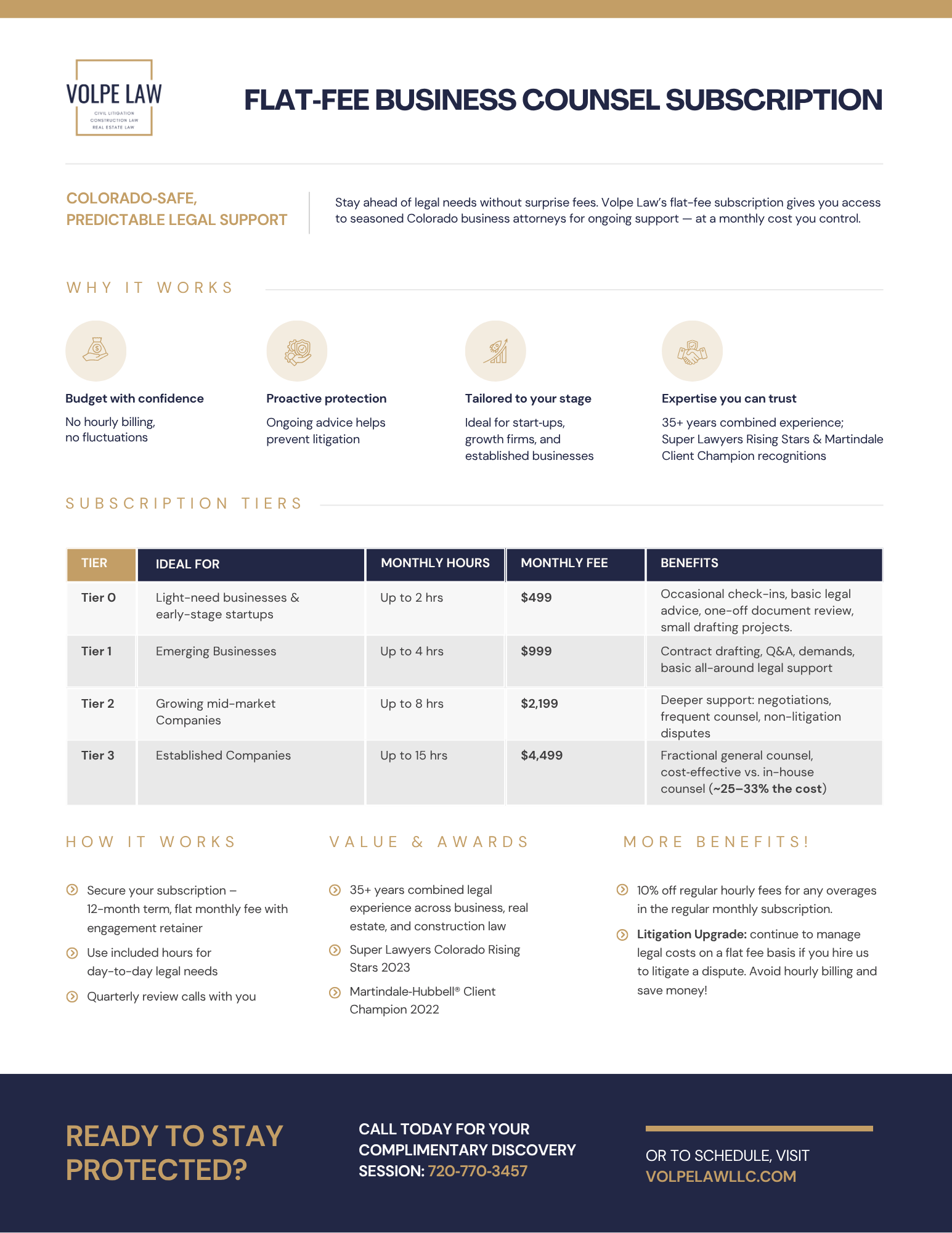
A $5,000 retainer is required for all pre-litigation dispute cases, while active litigation matters have a minimum retainer of $10,000. As of September 1, 2025, attorney rates vary between $315-$425/hour. These hourly rates are paid by the retainer account. Fees and retainers for contract reviews and smaller projects vary, with some cases best suited for a 1-2 hour paid complimentary discovery call at $400 per hour or $800 for two hours. All retainers are evergreen and refundable. Please call to inquire for further details.
DISCLAIMER
The information contained on this website is provided for informational purposes only. It is not legal advice and should not be construed as providing legal advice on any subject matter. Laws frequently change and therefore this content is not necessarily up to date, nor comprehensive. Contact us or another attorney with any legal questions specific to your matter. You may contact us by completing our complimentary discovery call.

Contact volpe law to request a complimentary discovery call
We offer a complimentary discovery call and we’ll gladly discuss your case with you at your convenience. Contact us today to request an appointment with one of our attorneys. Appointments subject to attorney availability.
Volpe Law is committed to answering your questions about Civil Litigation, Real Estate, Construction, Business Litigation, Breach of Contract, Tort Litigation, Mechanics’ Liens, and Contract Review & Drafting in Colorado.
Contact
19751 E. Mainstreet, #342
Parker, CO 80138
1115 Acoma Street, #320B
Denver, CO 80204
Office Hours: 09:00am - 05:00pm Mon, Tue, Wed, Thu, Fri
The material on this site and on any third-party web site link included on the Volpe Law, LLC website is for informational purposes only. Nothing on this website may be construed as legal advice. Laws frequently change and therefore this content is not necessarily up to date, nor comprehensive. Contact us or another attorney with any legal questions specific to your matter. You may contact us by calling us at 720-770-3457 or completing a complimentary discovery call. Using this website, filling out any forms, or communicating with Volpe Law, LLC through this site does not form an attorney/client relationship. Your matter may be subject to time limitations. You may be barred from taking any action if you do not timely act. Using or interacting with this website does not constitute your reliance on Volpe Law, LLC to take any action to represent you or preserve any claim that you may have or may assert. Please see Terms of Use for further information.